- Fertility & Women’s Wellness
- +91-9082745079
- lifefertilitycentre.nh@gmail.com
Fertility TreatmentsLaser-Assisted Hatching (LAH) in Mumbai
Laser-Assisted Hatching (LAH) in Mumbai – Advanced IVF Embryo Hatching Support
Laser-Assisted Hatching (LAH) is a specialised laboratory technique used during IVF treatment to create a small opening or thinning in the embryo's outer protective layer, known as the zona pellucida. This may help the embryo emerge from its surrounding shell before implantation.
At Life Fertility Centre, South Mumbai, Dr. Katha Desai provides individualised fertility care, including assessment of whether laser-assisted hatching may be appropriate during IVF or frozen embryo transfer (FET).
LAH is not routinely necessary for every IVF cycle. Its use depends on embryo characteristics, treatment history and clinical considerations. Importantly, current evidence does not establish that routine assisted hatching improves live birth rates.
What Is Laser-Assisted Hatching in IVF?
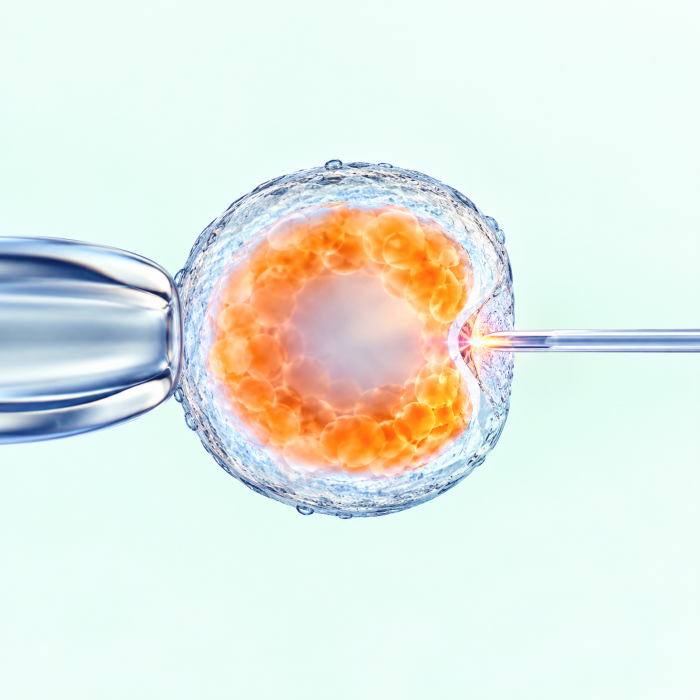
Laser-Assisted Hatching is an embryo micromanipulation procedure performed by a trained embryologist using a specialised laser system attached to an inverted microscope.
During normal embryo development, the embryo expands and eventually escapes from its protective outer layer before attaching to the uterine lining. This process is called embryo hatching.
In selected circumstances, an embryologist may use a precisely controlled laser to create an opening in the zona pellucida or reduce its thickness.
The procedure is performed outside the body, within the IVF laboratory, before embryo transfer. It does not involve applying a laser to the uterus or the patient.
The Science Behind Embryo Hatching
What Is the Zona Pellucida?
The zona pellucida is a glycoprotein-rich protective layer surrounding the egg and early embryo. It plays an important role in fertilisation and protects the developing embryo during its early stages.
As the embryo reaches the blastocyst stage, it expands and contracts, gradually weakening the zona pellucida until it can hatch.
Successful hatching is one of several steps required before implantation.
Why Might Some Embryos Have Difficulty Hatching?
Factors sometimes associated with changes in the zona pellucida include:
- Advanced maternal age: Age-related changes in eggs and embryos may affect developmental potential, although a direct benefit from LAH has not been established.
- Cryopreservation: Freezing and warming may alter the physical properties of the zona pellucida in some circumstances.
- Laboratory culture conditions: Embryos develop outside the body during IVF, and culture-related changes have been investigated.
- Zona pellucida characteristics: An unusually thick or abnormal-looking zona may prompt further embryological assessment.
These factors do not necessarily cause hatching failure. A thick zona pellucida alone does not establish that an embryo needs laser-assisted hatching.
How Does Laser-Assisted Hatching Work?
Modern LAH systems commonly use a non-contact infrared diode laser, often operating at approximately 1,480 nm.
The laser delivers brief, precisely controlled pulses focused on a selected area of the zona pellucida. Absorption of laser energy produces a highly localised thermal effect that allows the embryologist to thin or open the shell.
Because the procedure is performed under microscopic visualisation, the embryologist can select the treatment location and control the extent of the opening.
Although modern laser systems provide precise micromanipulation, they are not entirely free from thermal effects or procedural risks.
Mechanical vs. Chemical vs. Laser-Assisted Hatching
| Method | How it works | Considerations |
|---|---|---|
| Mechanical hatching | Uses a fine microneedle to create an opening | Requires careful physical manipulation |
| Chemical hatching | Uses an acidic solution to weaken the zona | Requires controlled chemical exposure |
| Laser-assisted hatching | Uses focused laser pulses to thin or open the zona | Offers precise, reproducible manipulation without direct mechanical contact |
Laser-assisted methods are widely used in modern embryology laboratories because of their precision and procedural control.
However, greater technical precision does not automatically translate into improved pregnancy or live birth outcomes.
Who May Be Considered for Laser-Assisted Hatching?
LAH may be discussed in selected IVF cases following clinical and embryological evaluation.
1. Repeated IVF Implantation Failure
For patients who have experienced unsuccessful embryo transfers, the fertility specialist may review embryo development, transfer conditions, uterine factors and previous treatment outcomes.
LAH for repeated IVF failure has been investigated, but available evidence does not demonstrate a consistent improvement in live birth rates.
2. Maternal Age Above 35 Years
Advanced maternal age may influence egg quality and embryo development. However, age alone is not a sufficient reason to recommend assisted hatching.
3. Unusual Zona Pellucida Thickness
A zona pellucida measuring approximately 15–18 micrometres or more may be assessed in the context of laboratory findings.
There is no universally validated thickness threshold that establishes a benefit from LAH.
4. Frozen Embryo Transfer (FET)
Laser hatching FET may be considered in selected circumstances following embryo warming.
However, routine assisted hatching of frozen-thawed embryos is not supported by reliable evidence of improved live birth outcomes.
5. Embryo Biopsy for Preimplantation Genetic Testing
Laser technology may also be used to create an opening in the zona pellucida during preparation for embryo biopsy.
This is a distinct laboratory application from assisted hatching intended to improve implantation.
Step-by-Step Laser-Assisted Hatching Procedure
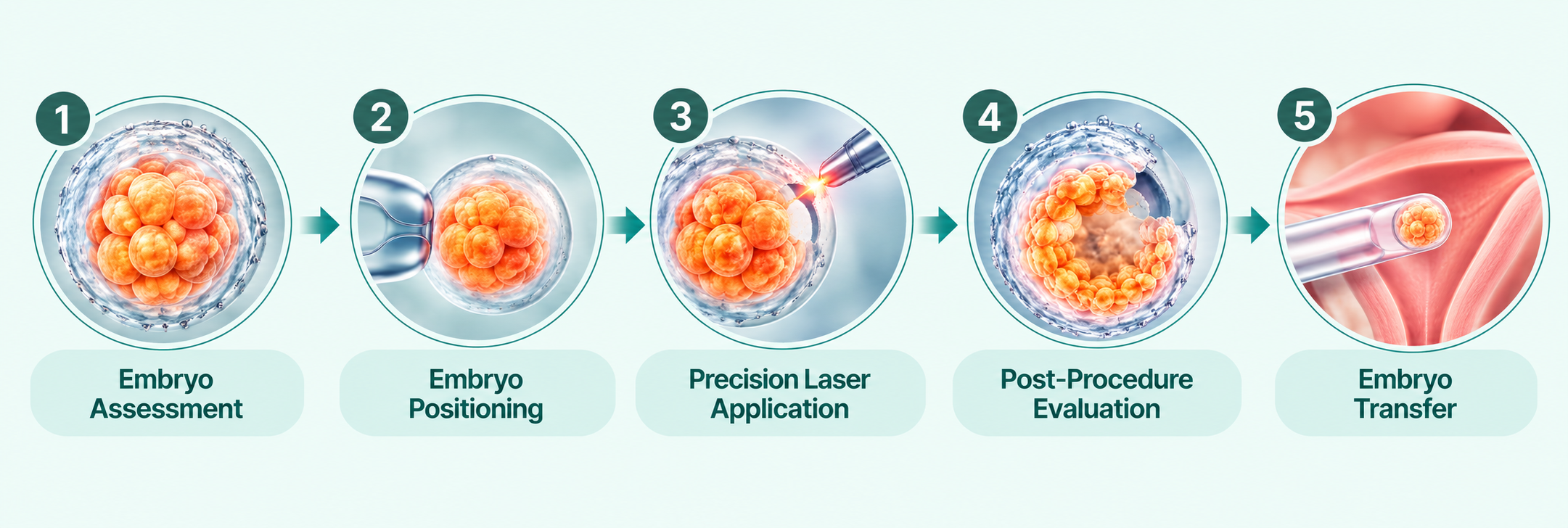
Step 1: Embryo Assessment
The embryologist evaluates embryo development, morphology and zona pellucida characteristics before deciding whether intervention is appropriate.
Step 2: Embryo Positioning
The embryo is positioned under an inverted microscope equipped with a laser micromanipulation system.
Step 3: Precision Laser Application
Controlled laser pulses create a small opening or thin a selected portion of the zona pellucida while minimising exposure of the embryo's cells.
Step 4: Post-Procedure Evaluation
The embryologist checks the embryo and documents the procedure according to laboratory protocols.
Step 5: Embryo Transfer
The embryo is transferred or cultured further according to the individual IVF treatment plan.
LAH may be performed at the cleavage stage, commonly Day 3, or at the blastocyst stage on Day 5 or 6, depending on the laboratory protocol and clinical purpose.
Is Laser-Assisted Hatching Safe?
Laser-assisted hatching is generally a brief laboratory procedure when performed by appropriately trained embryologists using validated equipment.
However, patients should understand its potential limitations and risks.
- Embryo damage: Incorrect laser placement or excessive energy may damage embryonic cells.
- Thermal exposure: Modern systems minimise unwanted heat exposure, but thermal effects are not completely absent.
- Monozygotic twinning: Some studies have reported an association between assisted hatching and identical twinning, although findings vary.
- Congenital outcomes: Available research has not established a clear causal increase in major congenital abnormalities attributable specifically to modern LAH, but long-term safety evidence remains limited.
The decision to perform LAH should therefore consider the possible risks alongside the uncertain clinical benefits.
Laser-Assisted Hatching Success Rate in Mumbai
The success of an IVF cycle depends on several factors, including:
- Maternal age and egg quality
- Embryo chromosomal status and developmental potential
- Endometrial receptivity
- Previous fertility treatment history
- Embryology laboratory practices
Although some studies have reported improvements in intermediate outcomes such as clinical pregnancy rates in particular populations, high-quality evidence has not demonstrated a reliable improvement in live birth rates with routine assisted hatching.
There is no scientifically established LAH-specific success rate applicable to every patient in Mumbai.
At Life Fertility Centre, patients can discuss their individual IVF prognosis and whether any additional laboratory procedure is justified.
Dr. Katha Desai – Fertility Specialist in South Mumbai
MBBS, MS (Obstetrics & Gynaecology), DNB (Obstetrics & Gynaecology)
Fellowship in Reproductive Medicine | Advanced Diploma in Reproductive Medicine, Kiel, Germany
Dr. Katha Desai leads Life Fertility Centre at Nirmala Maternity & Surgical Hospital, South Mumbai.
Her specialised training in reproductive medicine, including advanced education in Germany, supports an individualised approach to fertility assessment and assisted reproductive treatment.

She has contributed to FOGSI clinical manuals and is an active member of the Mumbai Obstetric & Gynaecological Society (MOGS).
Her approach focuses on understanding each patient's fertility history, discussing appropriate treatment options and avoiding unnecessary interventions.
Laser-Assisted Hatching Cost in Mumbai
The cost of laser-assisted hatching in Mumbai may vary depending on the fertility centre, embryology laboratory and overall IVF treatment plan.
Factors affecting LAH pricing include:
- Whether LAH is included in the IVF package
- Whether it is charged separately during frozen embryo transfer
- Embryology laboratory procedures and equipment
- Number of embryos requiring laboratory manipulation
- Associated IVF or FET services
Patients should request a written cost estimate that clearly identifies the LAH fee and distinguishes it from embryo transfer, medications, freezing, warming and other laboratory charges.
Life Fertility Centre can provide treatment-specific pricing following consultation and review of the proposed laboratory plan.
Frequently Asked Questions About Laser-Assisted Hatching
Is laser-assisted hatching painful?
Does laser-assisted hatching increase IVF success rates?
Is laser-assisted hatching necessary for frozen embryo transfer?
Can laser-assisted hatching damage the embryo?
What is the cost of laser-assisted hatching in Mumbai?
Consult Dr. Katha Desai for Laser-Assisted Hatching in Mumbai
Laser-assisted hatching is an additional IVF laboratory procedure that may be considered in selected cases based on embryo development, fertility history and previous treatment outcomes.
At Life Fertility Centre, Dr. Katha Desai provides personalised fertility consultations to assess whether laser-assisted hatching is appropriate and guide you towards suitable IVF treatment options.
Life Fertility Centre
Nirmala Maternity & Surgical Hospital, South Mumbai
- Fertility First Steps - Counselling for Planning Naturally
- Fertility Assessment Tests
- Ovulation Induction
- IUI (Intrauterine Insemination)
- IVF (In Vitro Fertilization)
- ICSI (Intracytoplasmic Sperm Injection)
- FET (Frozen Embryo Transfer)
- Donor Oocyte And Embryo Programs
- Fertility Preservation
- LAH, Blastocyst Culture
- Genetic Screening
- TESA/ PESA